Rounds on Six
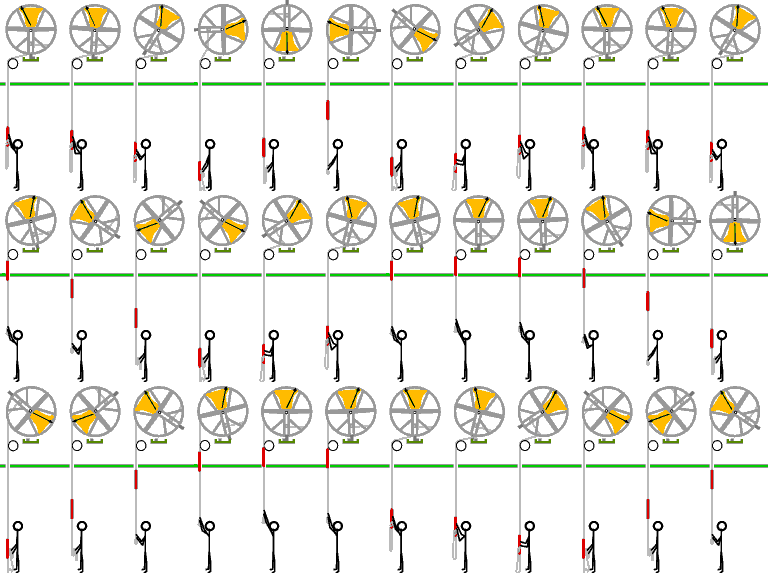
(Click on image to animate)
This is how bells are rung. In this image the treble, or lightest, bell is on the left and the tenor, or heaviest, bell on the right.
It shows “rounds” being rung on six bells, 123456, 123456, 123456 ……….. It will sound the same as going down a major scale on the piano; e.g. AGFEDC, AGFEDC, AGFEDC……..
Look at the left bell – notice how the red “sally” is pulled downwards and is then taken upwards as the bell rotates – this is called the “handstroke”.
When the rope is right up the ringer has hold only of the “tail-end” and (s)he pulls this downwards, the sally goes right down and bobs back up and is caught by the ringer; this is the “backstroke”.
In rounds the bells follow each other, leaving an even gap between each bell. You can listen to this clip to hear how it would sound
The green line represents the ceiling of the “Ringing Room” through which the ropes pass to reach the bells in the “Belfry”.
What you can see sticking out above the bell wheel, opposite the top of the bell, is the wooden “stay”, which rotates with the bell, making contact with the wooden “slider”, which is pushed back and forth, left to right and back again. This is the mechanism via which we stop the bells rotating, the bells are called to “Stand”. It is also the safety mechanism. If a ringer pulls too hard and/or fails to catch the sally the stay may break. It is much easier and cheaper to replace the stay than it would be to repair the damage that might have been caused otherwise.
(Image courtesy of Fortran Friends)