Can I Learn to Ring Church Bells?
Click here to go to our Learn to Ring Enquiry Form
Bellringing is a challenging and rewarding activity. It is not “instant” and it does take a while to become a competent ringer. It is very satisfying when you reach the stage at which you are able to control your bell and ring with other ringers.
There is a huge age range in ringing. Ringers tend to be over the age of about 10 or 11, but only so that they are tall and strong enough to be able to control the bell and take instructions. Ringing is very inclusive – we are all ringers, regardless of age. Handbell ringing is also an option for those who are too young or less physically able.
Ringing requires co-ordination, rhythm, concentration, listening and perseverance! A good technique is key. You don’t have to be strong, mathematical or musical, but these attributes can help or may direct your interests as you develop as a ringer. You can be of any faith or not religious at all.
Once gained, bell ringing is a skill for life you’ll never forget and can open up a lifetime of experiences and enjoyment. You are always learning. There is always something more to do if you want to. This means people who have been ringing for many years are still interested in and enthusiastic about bellringing.
This is a super video which gives you a flavour of what ringing is all about.
When and where are Church bells rung?
English style ringing is also called ‘full circle ringing’ and evolved in England about 400 years ago. The style of ringing and the way the bells are hung, are intimately connected and evolved together. There are approximately 5,000 towers around the world, mostly in the UK and over 40,000 ringers in the UK.
Most ringers ring in their local tower on Sundays and also one practice night each week. There are also many opportunities to ring over and above this for people who want to.
Competent ringers are welcome to join other bands on Sundays or for their practices and often benefit from ringing with other ringers who are a bit more experienced than they are. There is a strong “bellringing community” that is very welcoming and encouraging to other ringers.
Handbells can be rung anywhere as they are small and portable!
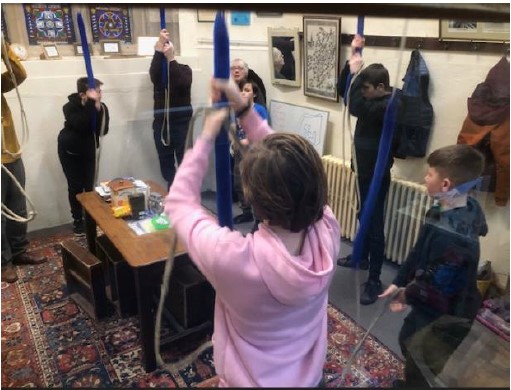
The Coventry Spires Youth Bellringing Group at one of their monthly practices
What’s happening “upstairs”?
The bell and wheel are both mounted on the headstock, which is free to rotate on 2 bearings attached to a frame. The bell is shown here mouth down, at rest, but when ringing, it swings through 360 degrees from mouth-up to mouth-up and back again.

The rope is attached to the wheel, passing round it and down through a pulley block to the ringing room many feet below. The rope is all that connects the ringer below to the bell above. It wraps alternately each way round the wheel, so that the rope is in tension as the bell comes to rest at the end of each swing, and the ringer can control it by exerting more or less force as required. The diagram below shows the position of the bell and rope at each stroke. The bell can be rested when it is mouth up, with the stay resting against the slider bar underneath the bell. It slides in order to let the bell go just beyond the balance point in each direction and stop. The slider bar, seen end on in the diagram, moves about a foot, within a slot in the runner board (shown grey above).

Less rope is wound round the wheel at handstroke than at backstroke (see arrows). As a result, the ringer has surplus rope at handstroke, and therefore holds the ‘sally’ – the fluffy coloured part some way from the rope end. The sally disappears through the ceiling each backstroke – see the following animations courtesy of the Washington Ringing Society.
See how the red “sally” is pulled down and then the rope is taken up through the ceiling as the bell rotates clockwise. It is then pulled back down, the bell rotates anticlockwise, and the ringer catches it when it bounces back up. The six ringers ring after each other in turn (called “rounds”), keeping an even space between the bells. It is from rounds that most ringing starts and it returns to rounds before it stops. The clapper strikes on opposite sides of the bell at each stroke. As the bell comes to rest, the clapper keeps going, so it strikes the leading edge each time. This means that there is a noticeable time delay between pulling the rope and the bell sounding, which is an additional challenge to master!
What is Involved in Learning to Ring?
The Association of Ringing Teachers (ART) have developed a 5-stage learning pathway called “Learning the Ropes” and have accredited instructors. The sections below give you a flavour of what is involved in each of these stages. How long it takes to navigate these stages is very much an individual thing and teaching is therefore always person centred. This link takes you to some detailed information on the 5 stages on the ART website.
There are lots helpful additional resources aligned to the 5 stages under “Your Training Resources” on this website within the “Training” tab that are well worth looking at to gain additional insight and understanding as you navigate each stage. http://ringingteachers.org/index.php?cID=273
The Pebworth Bells website contains some excellent resources on the art and science of bellringing, including change ringing basics, listening games, method ringing resource and much more. Pebworth Bells – Pebworth Bells
Level 1 – Bell Handling
The first stage is to develop the skills to ‘handle’ the bell i.e. the technique to control the bell using the rope. This is done on a one-to-one basis with your trained instructor and is often done on a silenced bell or simulator whereby a computer is used to simulate the sound of the bell. You will usually be taught each of the two movements, or ‘strokes’, by ringing separately and then helped to put them together. The technique is all about holding the rope correctly, moving with it and catching the sally in the right place. You will also need learn how to prepare the bells for ringing by ringing them ‘up’ and ‘down’ again safely. The following video gives you an insight into what’s involved in the stage 1 of learning to ring.
Level 2 – Foundations Skills
Bell ringing is all about working as part of a team, so once you can ‘handle’ your bell you are quickly introduced to ringing with the rest of the ‘band’ of ringers.
The key skills learnt are the ability to watch and listen to the ringing to know when you pull and sound your bell and to be able to varying the pace of your ringing to fit in with the group. This is again usually done with a personal tutor, who will help you to develop the skills.
Level 3 – Introduction to Change Ringing
To get the most out of bell ringing, the challenges lie in change ringing. This is when bell ringers follow a pattern called a method, where the bells change the order in which they strike each time.
You’ll learn about the structure of methods, how to remember them and how to move the place in the order that your bell strikes. There is often some theory and reading to do, but your tutor and the band will help out with advice.
You will start to ring quarter peals on the treble and covering on the tenor. A quarter peal is 1260 changes and takes about 45 minutes to ring.
Level 4 – Novice Change Ringer
Once you have grasped the key skills of change ringing, there are more complicated patterns of methods to learn and also variations to existing ones you know. There is a world of opportunity to learn new things, and using the clever approach bell ringers have to memorise the pattern it is not even too difficult!
You’ll be ringing a quarter peal on an inside bell.
Level 5 – Change Ringer
You finish the end of your initial learning to ring process by taking part in more quarter peals, which are recorded on Bellboard and the Ringing World, the official journal of bellringing. You will also start calling 120 changes of doubles.
There are then thousands more methods to discover, places to visit and new ringers to meet across the world.

Practice Night at Honiley
What next?
After Level 5, students can go on to “Learning the Ropes Plus”, taking them into more complex methods and conducting. Students will also be encouraged to visit different bell towers, ring on 8 or more bells and take part in and organise quarter peals and peals.
If you are not already a member of the Coventry Diocesan Guild of Church Bellringers, then please consider becoming a member.
A copy of the New Members Handbook provides information about the Guild, including Safeguarding, Safety and Etiquette.
Learn to Ring Information Request
If you would like to learn to ring, we can help find a bell tower near you.
Please complete this form and we will get back to you with some options.